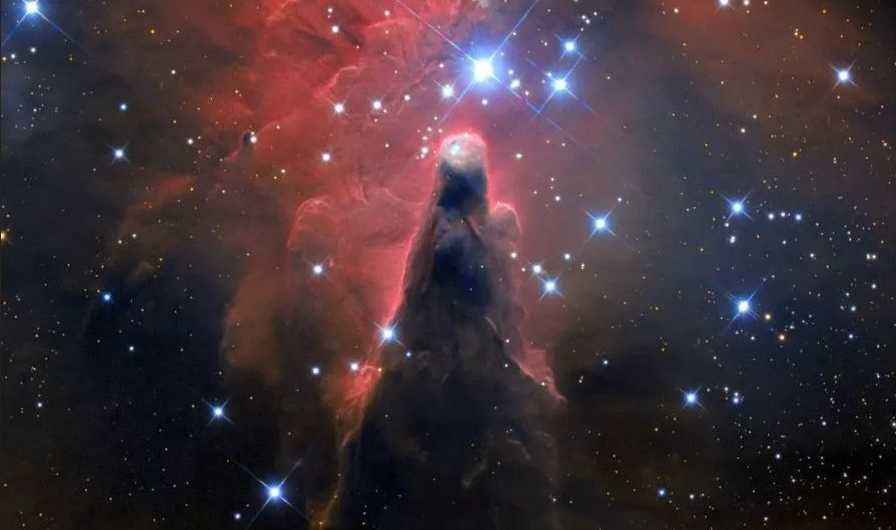
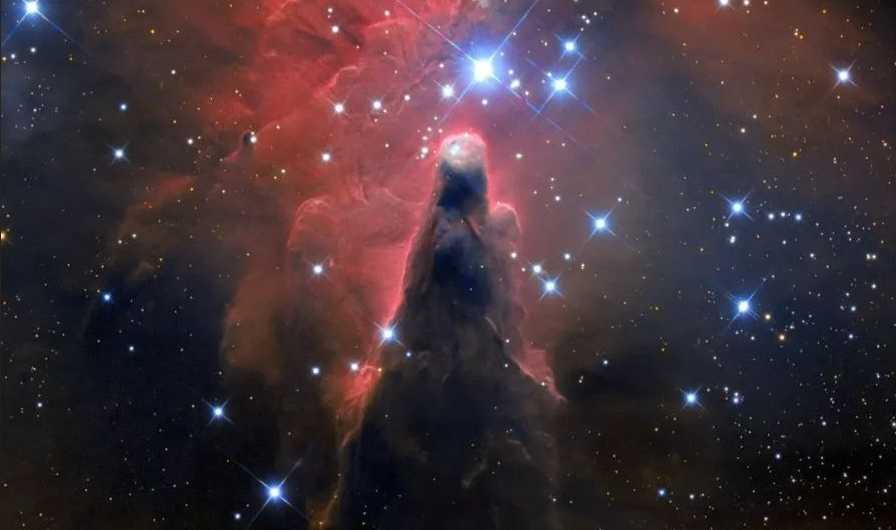
The Cone Nebula earns its name from its tapered shape, formed by dense interstellar dust clouds that block light from background stars. When viewed inverted, its outline resembles a hooded figure, sparking imaginations about mythical guardians or sci-fi antagonists. But beneath this eerie facade, the nebula is a hive of stellar birth: ultraviolet radiation from the cluster’s hottest stars (like S Monocerotis) ionizes hydrogen gas in the nebula, creating the vibrant red glow characteristic of emission nebulae.
Source: Images from the Internet, if there is any infringement, please contact the removal of
Astronomers estimate the Cone Nebula lies ~2,500 light-years from Earth, with its "tip" pointing toward us. The dark lanes within its structure are actually dense cores of gas and dust where new stars may be forming—though visible light telescopes can’t penetrate these regions, infrared observations reveal embryonic stars hidden within the nebula’s "robes."
While the Cone Nebula’s shadowy form suggests darkness, its role in astrophysics is luminous: as an emission nebula, it serves as a textbook example of how massive stars shape their environment. The radiation they emit carves out cavities in surrounding gas, while stellar winds sweep up dust into dramatic structures like the Cone’s pointed apex.
For stargazers, the nebula is best observed with a telescope in late winter, when it’s high in the southern sky. Though light pollution dims its glow, astrophotographers often capture its striking contrast: the inky black dust lanes against the fiery red hydrogen backdrop, with the Christmas Tree cluster’s "twinkling lights" (young blue stars) framing the scene. Far from a "dark messenger," the Cone Nebula is a testament to the universe’s ability to weave beauty from chaos—proving that even the most ominous cosmic silhouettes may cradle the seeds of new stars.